NeuroAI: Unraveling How Neural Architecture and Dynamics Drive Intelligent Computation
Our lab approaches biological and artificial intelligence as a unified problem in NeuroAI. Rather than treating circuit anatomy, population activity, and task performance as separate topics, we study how they interact as a single dynamical system across neuroscience, physics, computer science, and mathematics. Insights into how cortical circuits compute directly guide the design of brain-like intelligent systems, while theoretical and machine learning tools help decode the working principles of the brain.
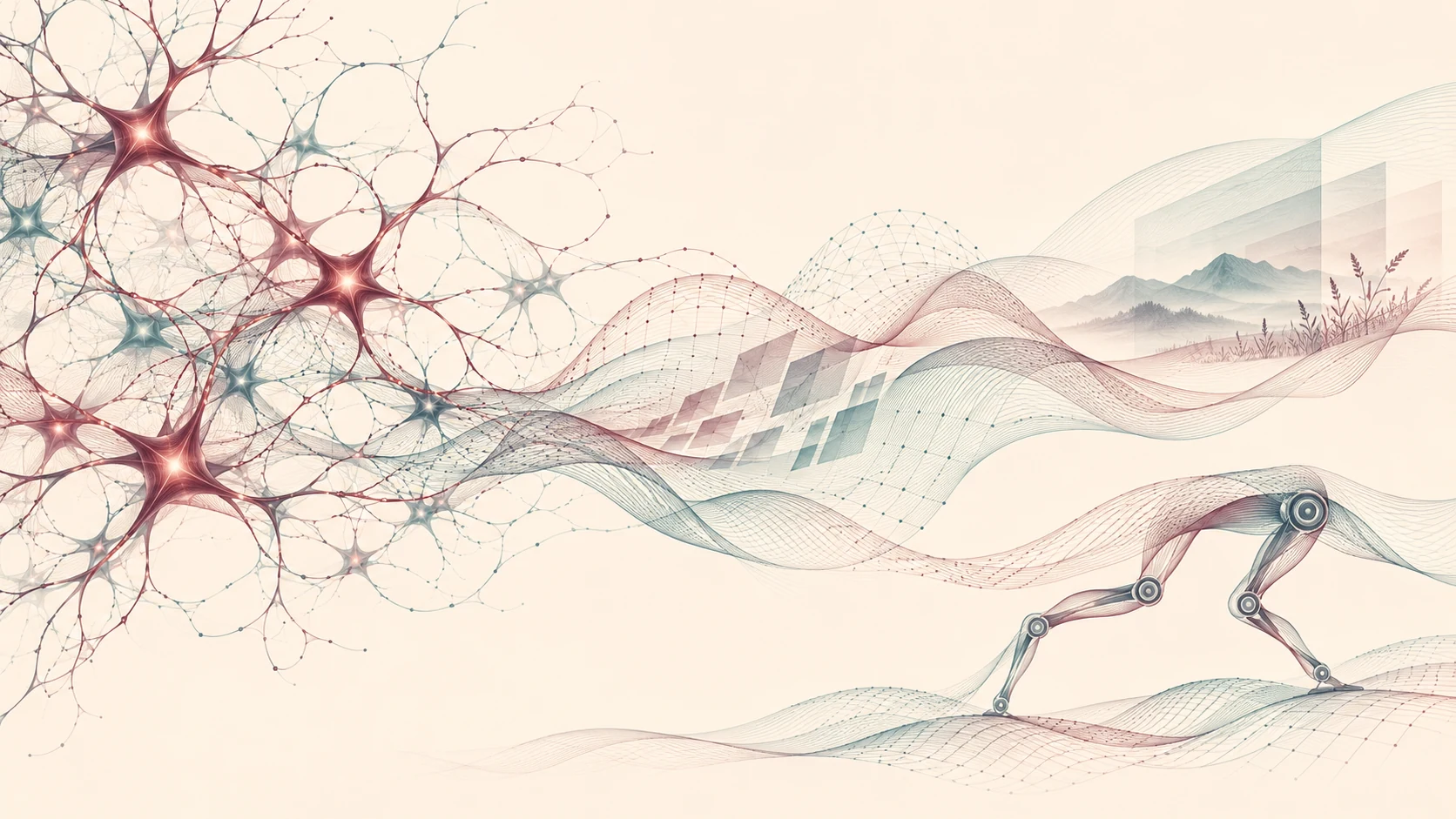
Conceptual illustration
A shared scientific question
The Core Coupling: Relating Architecture, Dynamics, and Computation
Our central scientific premise is that neural computation emerges from the tight coupling among physiological architecture, emergent dynamics, and functional behavior. Our approach begins by modeling neural networks grounded in biological connectivity and cellular physiology, then analyzes the dynamical structures, such as waves, oscillations, attractors, and criticality, that arise from those circuits. By characterizing the spatiotemporal correlations embedded in these dynamical structures, we uncover the working mechanisms of cortical computation and distill them into mathematical principles for brain-like intelligence.
Cortical circuits are sparse, heterogeneous graphs rather than uniform layers. Combining data-driven primary visual cortex models, generative latent connectome representations, and spatial spectral theory, we reveal how local excitation-inhibition rules, cellular diversity, and anatomical motifs sculpt traveling waves, input-slaved transients, and flexible condition-dependent spike-order codes that drive robust sensory processing and working memory.
Biological networks compute and learn far from equilibrium. We show how modulating ongoing spontaneous activity accelerates active perception, how critical transition states generate superdiffusive attention spotlights and enable strictly local online rules to achieve global credit assignment, and how evolved heterogeneous plasticity and continuous attractor manifolds support rapid, few-shot adaptation.
Translating neurophysical principles into machine learning yields architectures that learn from less data and compute with high efficiency. By embedding scale-free spatial hierarchies, hippocampal multiscale positional codes, spectral state-space priors, and recurrent spiking dynamics into modern models, we advance high-resolution diffusion generation, sequence modeling, microsecond stereo depth estimation, and point-cloud-free robotic grasping.
Research infrastructure
btorch
Brain-inspired differentiable PyTorch toolkit for neuromorphic and computational neuroscience research.