NeuroAI Multimodal Intelligence Workshop at AAAI 2026 · Workshop paper
Decoding Cortical Microcircuits: A Generative Model for Latent Space Exploration and Controlled Synthesis
A generative latent model compresses mouse cortical microcircuit connectomes to explore structure-function relationships and synthesize bio-plausible networks.
The scientific question
Can high-dimensional cortical microcircuits be represented and synthesized through a compact latent code?
Directly analyzing structure-function links in massive connectome graphs is intractable, though developmental biology suggests circuits arise from compressed genetic blueprints.
The core idea
Generative Microcircuit Latent Compression
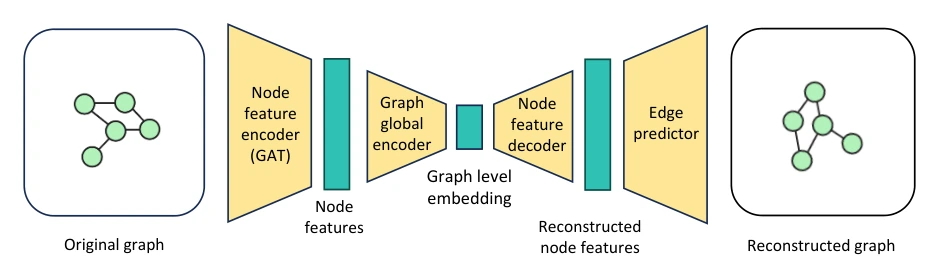
We train a variational generative model on mouse cortical microcircuit connectivity maps, linking positions in the learned latent space to computational performance on reservoir tasks.
What we found
Controlled Bio-Plausible Circuit Synthesis
The compressed latent space captures essential microcircuit structure, associates encoded topologies with computational functions on reservoir tasks, and enables controllable generation of novel synthetic microcircuits with desired structural features.
Continue the question
Related reading
- Connectome-to-Function: Conditional Generative Latent Representations for Reservoir ComputingarXiv · 2026
- Unveiling and Steering Connectome Organization with Interpretable Latent VariablesarXiv · 2025
Cite this work
Xingyu Liu, Yubin Li, Guozhang Chen. Decoding Cortical Microcircuits: A Generative Model for Latent Space Exploration and Controlled Synthesis. NeuroAI Multimodal Intelligence Workshop at AAAI 2026.