NeurIPS 2025 · Conference paper
Bridging Scales: Spectral Theory Reveals How Local Connectivity Rules Sculpt Global Neural Dynamics in Spatially Extended Networks
Spectral theory links microscopic excitation-inhibition connectivity rules to eigenvalue signatures that predict macroscopic cortical waves, oscillations, and chaos.
The scientific question
How do local synaptic connectivity rules sculpt global spatiotemporal brain dynamics?
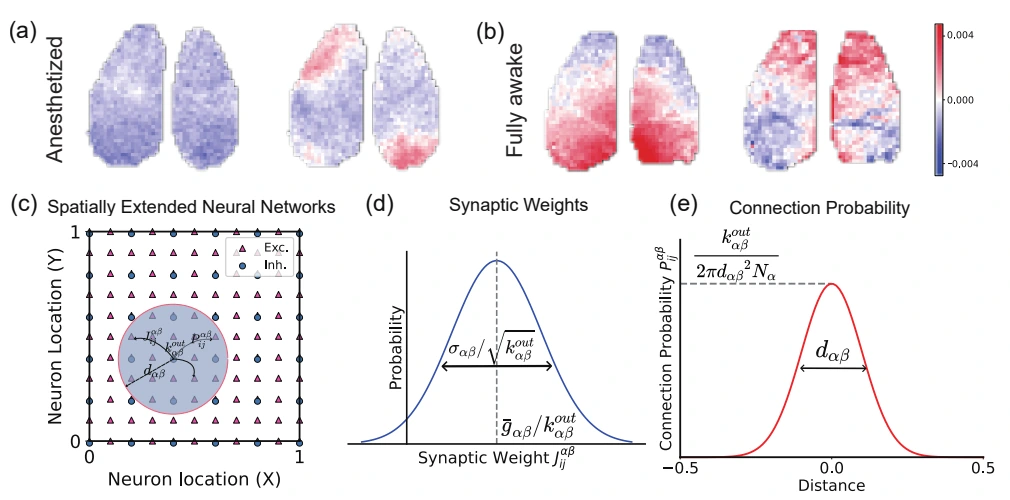
Cortical activity shifts across arousal states between asynchronous firing, oscillations, bumps, and waves, yet connecting local circuit parameters to macroscopic regimes remained difficult.
The core idea
Spatial Connectivity Spectral Theory
We derive an analytical spectral theory for spatially extended excitatory-inhibitory networks, mapping projection ranges, connection strengths, and densities onto bulk disk and outlier eigenvalues.
What we found
Analytical Prediction of Dynamical Regimes
The eigenvalue spectrum quantitatively predicts transitions among synchronous, asynchronous, oscillatory, bump, traveling-wave, and chaotic regimes, offering a principled starting point for inferring effective connectivity changes from macroscopic brain activity across arousal states.
Continue the question
Related reading
- A spatiotemporal mechanism of visual attention: Superdiffusive motion and theta oscillations of neural population activity patternsScience Advances · 2022
- Neural heterogeneity enhances reliable neural information processing: Local sensitivity and globally input-slaved transient dynamicsScience Advances · 2025
Cite this work
Yuhan Huang, Keren Gao, Dongping Yang, Sen Song, Guozhang Chen. Bridging Scales: Spectral Theory Reveals How Local Connectivity Rules Sculpt Global Neural Dynamics in Spatially Extended Networks. NeurIPS 2025. doi:10.52202/085713-2217.