Science Advances · 2025 · Journal article
Neural heterogeneity enhances reliable neural information processing: Local sensitivity and globally input-slaved transient dynamics
Cellular and synaptic heterogeneity disrupts intrinsic coherent waves to produce locally sensitive, globally input-slaved transient dynamics for reliable coding.
The scientific question
How do variable cortical circuits represent external stimuli reliably across trials?
Cortical activity fluctuates across trials and time, raising the puzzle of how noisy populations maintain consistent, high-fidelity stimulus representations.
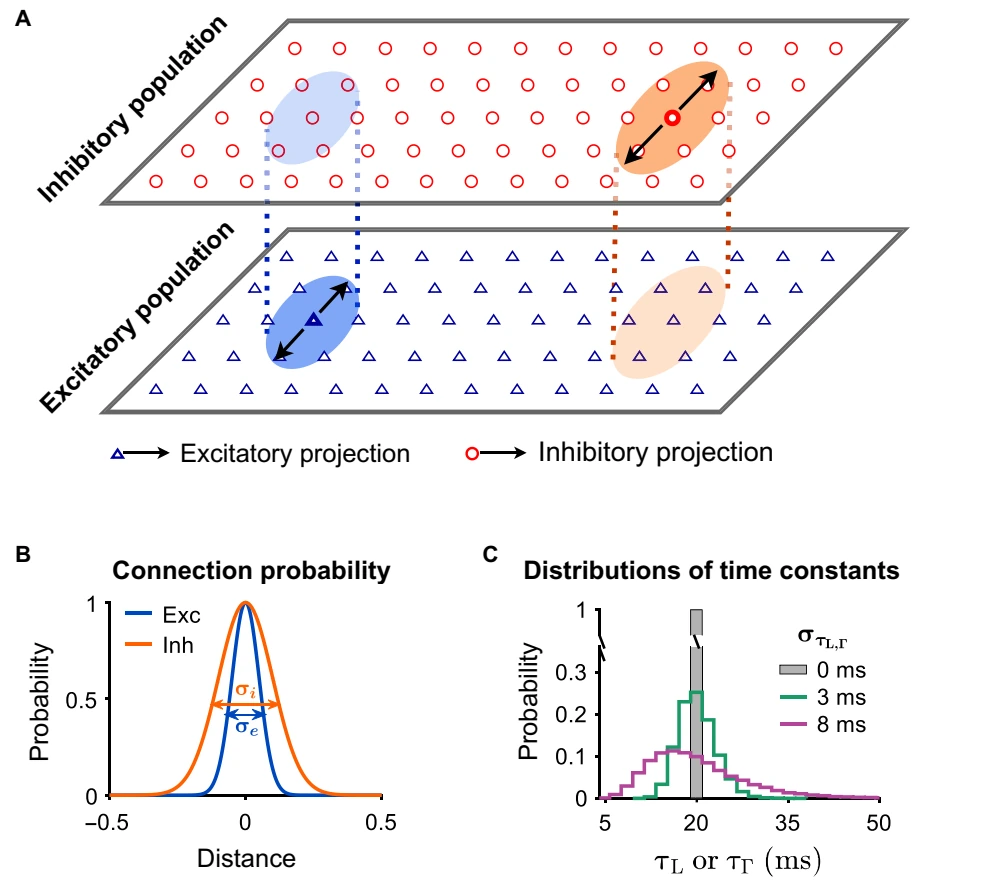
The core idea
Heterogeneous Spiking Circuit Modeling
We incorporate biological diversity in neuronal timescales, spike thresholds, input projections, and in-degrees into spatially extended spiking circuit models driven by external stimuli.
What we found
Input-Slaved Transient Information Processing
Heterogeneity breaks up intrinsic coherent activity patterns, increasing local responsiveness and locking global transient trajectories to external inputs, which also improves liquid-wave reservoir computing.
Continue the question
Related reading
- Computing by modulating spontaneous cortical activity patterns as a mechanism of active visual processingNature Communications · 2019
- Bridging Scales: Spectral Theory Reveals How Local Connectivity Rules Sculpt Global Neural Dynamics in Spatially Extended NetworksNeurIPS 2025 · 2025
Cite this work
Shengdun Wu, Haiping Huang, Shengjun Wang, Guozhang Chen, Changsong Zhou, Dongping Yang. Neural heterogeneity enhances reliable neural information processing: Local sensitivity and globally input-slaved transient dynamics. Science Advances, 2025. doi:10.1126/sciadv.adr3903.