Cognitive Neurodynamics · 2026 · Journal article
Redefining spiking neural networks through the lens of dynamical superspace
This perspective introduces dynamical superspace, a theoretical framework organizing spiking neural networks by temporal density and non-equilibrium state-space complexity.
The scientific question
How can spiking network theory unite deep learning with biological non-equilibrium dynamics?
Synchronous rate-based spiking networks overlook the computational capacity of asynchronous biological timing, heterogeneity, and transient non-equilibrium trajectories.
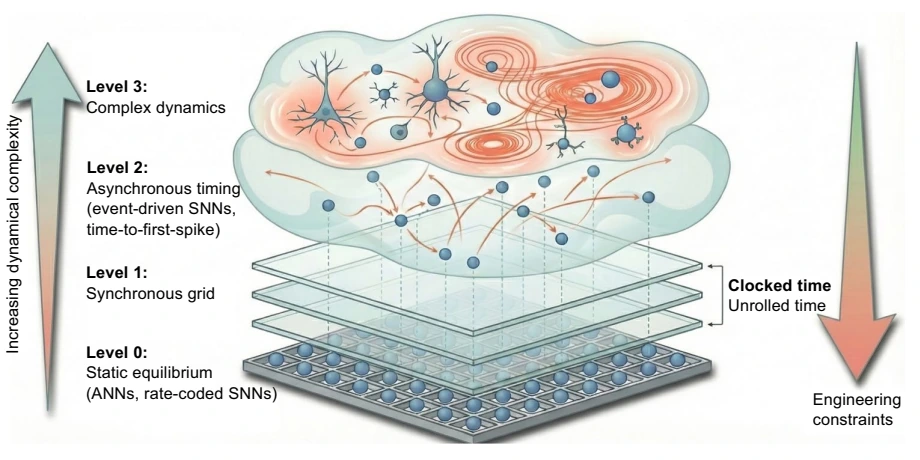
The core idea
Hierarchy of Temporal and State Complexity
The review organizes neural computation along a continuous superspace spanning clock-driven rate equilibria to asynchronous spike timing and complex non-equilibrium transient dynamics.
What we found
Roadmap for Native Neuromorphic Intelligence
The perspective outlines how heterogeneity, criticality, and evolutionary priors can bridge global optimization with local execution for low-latency event perception and long-context memory.
Continue the question
Related reading
- Neural heterogeneity enhances reliable neural information processing: Local sensitivity and globally input-slaved transient dynamicsScience Advances · 2025
- Global Credit Assignment via Dynamical CriticalityICML 2026 · 2026
Cite this work
Guozhang Chen, Junrong Qi, Xingyu Liu, Qixuan Fan, Zhuoheng Gao, Songcheng Xu, Xuliang Wang, Yujie Wu, Dongping Yang, Douglas Zhou, Tiejun Huang. Redefining spiking neural networks through the lens of dynamical superspace. Cognitive Neurodynamics, 2026. doi:10.1007/s11571-026-10470-y.