ICLR 2026 · Conference paper
Discovering heterogeneous synaptic plasticity rules via large-scale neural evolution
Large-scale multi-objective evolution in a realistic mouse visual cortex model uncovers biologically plausible, heterogeneous synaptic plasticity rules.
The scientific question
How do diverse synaptic plasticity mechanisms coordinate to produce functional learning?
Cortical synapses use diverse cell-type-specific plasticity rules, but how heterogeneous local mechanisms jointly give rise to adaptive behavior remains unclear.
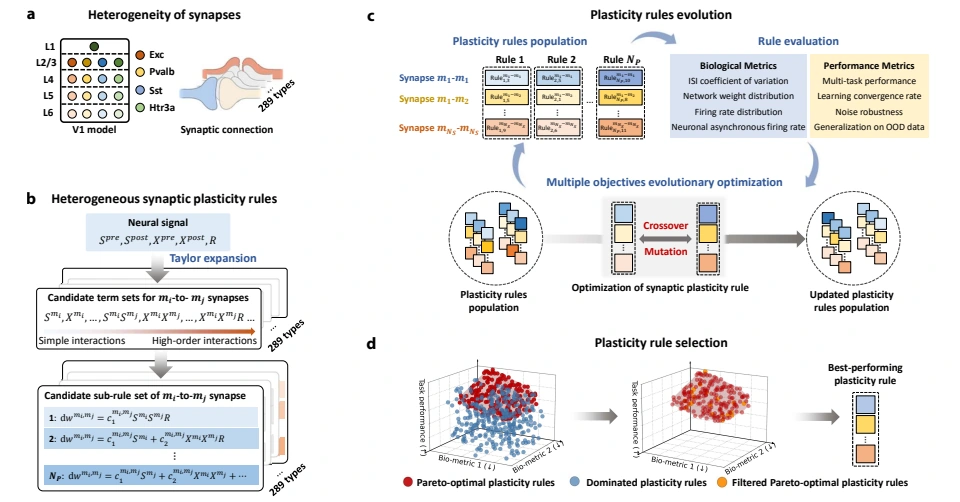
The core idea
Multi-Objective Evolutionary Rule Discovery
We parameterize pre- and postsynaptic spikes, eligibility traces, and neuromodulation via Taylor expansions inside a mouse V1 model, evolving over 2,600 plasticity parameters against biological and task objectives.
What we found
Computational Degeneracy and Few-Shot Learning
Evolution discovers mathematically distinct plasticity families that achieve comparable visual performance, demonstrating computational degeneracy alongside cross-scale robustness and rapid few-shot adaptation.
Continue the question
Related reading
- Evolutionary learning in neural networks by heterosynaptic plasticityiScience · 2025
- A data-based large-scale model for primary visual cortex enables brain-like robust and versatile visual processingScience Advances · 2022
Cite this work
Ziyuan Ye, Beichen Huang, Yujie Wu, Guozhang Chen, Jibin Wu. Discovering heterogeneous synaptic plasticity rules via large-scale neural evolution. ICLR 2026.