Science Advances · 2022 · Journal article
A data-based large-scale model for primary visual cortex enables brain-like robust and versatile visual processing
A comprehensive data-based model of primary visual cortex achieves versatile, noise-robust visual processing with sparse, energy-efficient neural coding.
The scientific question
Can an anatomically realistic primary visual cortex model support versatile visual processing?
Convolutional neural networks lack biological circuit structure, consume substantial energy, and remain fragile to sensory noise compared with mammalian vision.
The core idea
Multi-Task Evaluation of Bio-Realistic V1
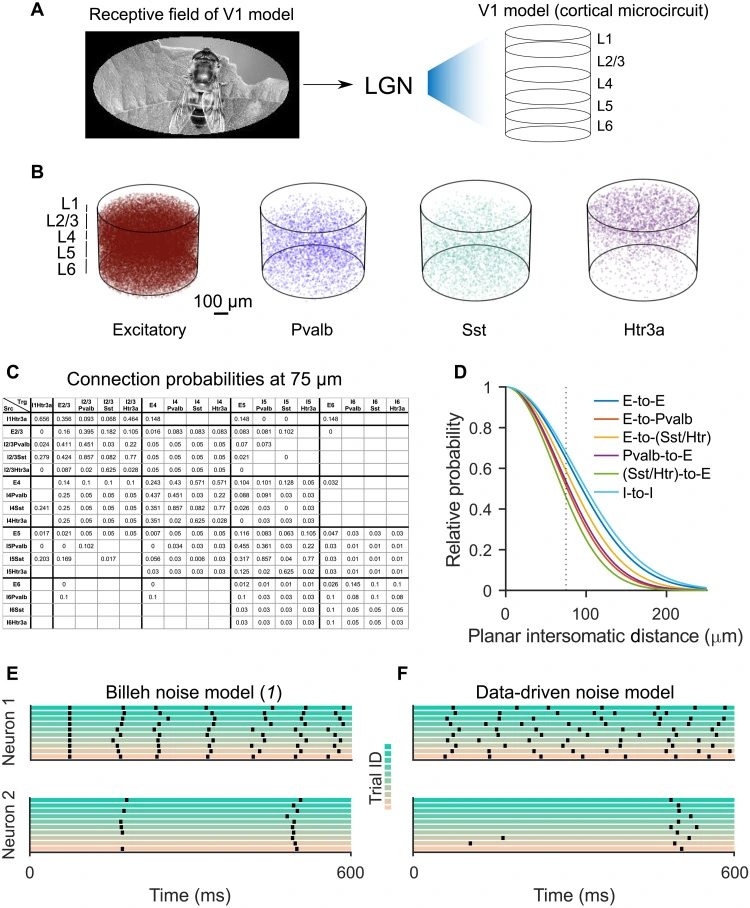
We evaluate a large-scale spiking model of area V1 incorporating detailed anatomical connectivity and neurophysiological cell properties across diverse spatial and temporal visual tasks.
What we found
Brain-Like Versatility and Noise Robustness
A single data-driven V1 circuit solves diverse visual tasks, integrates temporally dispersed inputs, reproduces cortical coding properties, and exhibits strong resilience to perturbation.
Continue the question
Related reading
- Data-based large-scale models provide a window into the organization of cortical computationsbioRxiv · 2023
- Discovering heterogeneous synaptic plasticity rules via large-scale neural evolutionICLR 2026 · 2026
Cite this work
Guozhang Chen, Franz Scherr, Wolfgang Maass. A data-based large-scale model for primary visual cortex enables brain-like robust and versatile visual processing. Science Advances, 2022. doi:10.1126/sciadv.abq7592.