bioRxiv · 2023 · Preprint
Data-based large-scale models provide a window into the organization of cortical computations
Training data-based large-scale cortical microcircuit models enables reverse-engineering of how anatomical structure organizes sparse, energy-efficient cortical computation.
The scientific question
How does the anatomical structure of cortical microcircuits organize neural computation?
Although neurobiology has mapped neocortical cell types and connectivity, experimental tools alone cannot fully resolve causal structure-function relationships.
The core idea
Reverse-Engineering Data-Driven Microcircuits
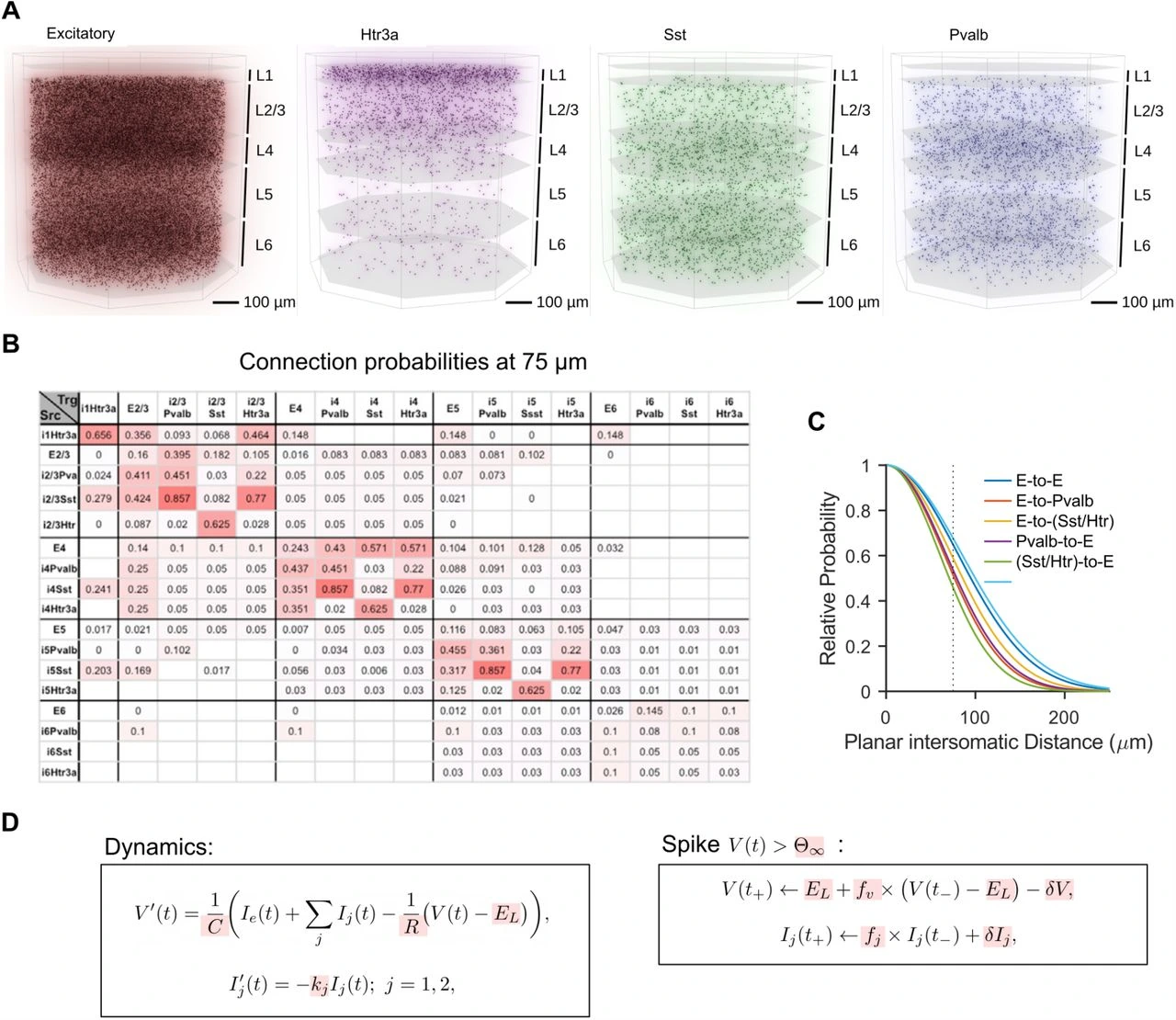
We train large-scale spiking models integrating detailed anatomical and physiological microcircuit data on natural tasks, then analyze internal dynamics to reverse-engineer their computational organization.
What we found
Sparse Coding and Testable Hypotheses
Trained microcircuits reproduce experimental cortical coding traits absent in standard deep networks, compute with energy-efficient sparse activity, and generate testable hypotheses for neuroscience.
Continue the question
Related reading
- A data-based large-scale model for primary visual cortex enables brain-like robust and versatile visual processingScience Advances · 2022
- Decoding Cortical Microcircuits: A Generative Model for Latent Space Exploration and Controlled SynthesisNeuroAI Multimodal Intelligence Workshop at AAAI 2026 · 2026
Cite this work
Guozhang Chen, Franz Scherr, Wolfgang Maass. Data-based large-scale models provide a window into the organization of cortical computations. bioRxiv, 2023. doi:10.1101/2023.04.28.538662.