ICLR 2026 · Conference paper
SpikeStereoNet: A Brain-Inspired Framework for Stereo Depth Estimation from Spike Streams
SpikeStereoNet estimates dense stereo depth directly from microsecond spike camera streams using iterative recurrent spiking neural network refinement.
The scientific question
How can stereo depth be estimated directly from asynchronous spike streams?
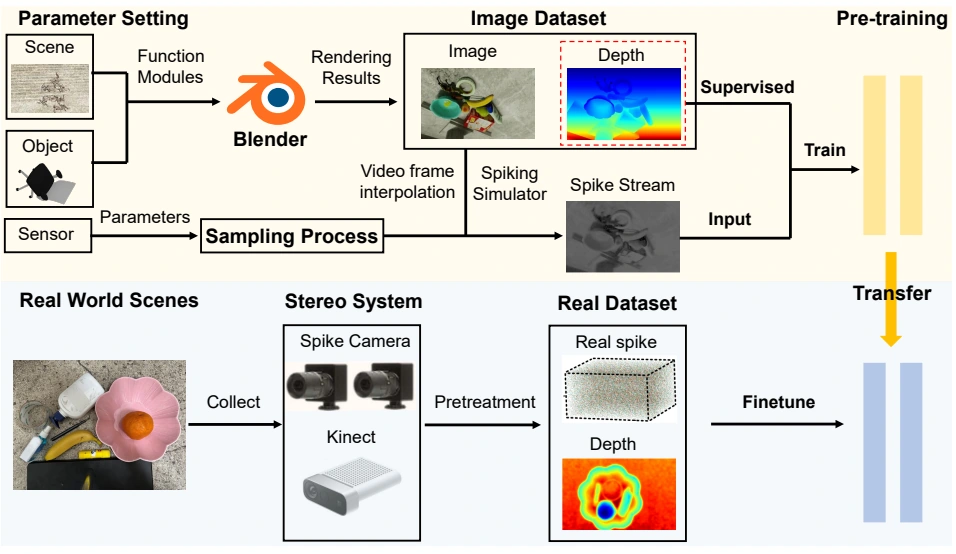
Conventional frame cameras blur fast motion, whereas microsecond spike cameras lack dedicated stereo algorithms and annotated benchmarks for depth perception.
The core idea
Recurrent Spiking Stereo Refinement
SpikeStereoNet fuses raw binocular spike streams and iteratively refines disparity estimates through a recurrent spiking update module, evaluated on new synthetic and real-world stereo benchmarks.
What we found
Robust Depth in Challenging Scenes
The model outperforms prior approaches on textureless surfaces and extreme lighting while maintaining high depth accuracy when trained on substantially reduced data.
Continue the question
Related reading
- SpikeGrasp: A Benchmark for 6-DoF Grasp Pose Detection from Stereo Spike StreamsarXiv · 2025
- SPKLIP: Aligning Spike Video Streams with Natural LanguagearXiv · 2025
Cite this work
Zhuoheng Gao, Yihao Li, Jiyao Zhang, Rui Zhao, Tong Wu, Hao Tang, Zhaofei Yu, Hao Dong, Guozhang Chen, Tiejun Huang. SpikeStereoNet: A Brain-Inspired Framework for Stereo Depth Estimation from Spike Streams. ICLR 2026.