ICML 2026 · Conference paper
The Hippocampal Place Field Gradient: A Bio-inspired Framework Building Multiscale Representation for Better Sample Efficiency
Modeling how grid cell projections generate multiscale hippocampal place fields inspires a Transformer positional embedding that improves sample efficiency.
The scientific question
How do discrete grid cell inputs generate continuous multiscale hippocampal place fields?
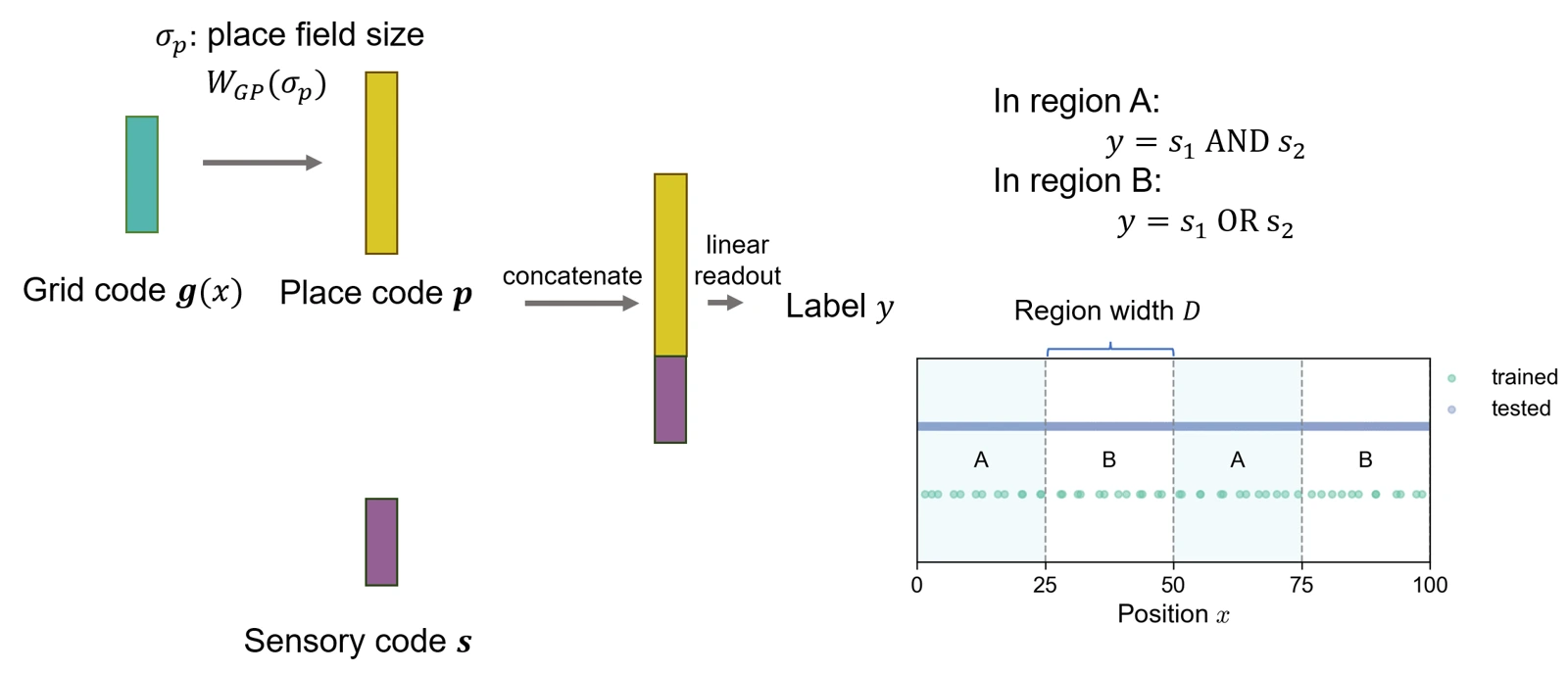
The hippocampus exhibits a continuous dorsal-ventral gradient of place field sizes, yet its circuit mechanism and computational benefit for learning remained unclear.
The core idea
Frequency-Dependent Grid Projection Decay
A theoretical model derives continuous place field gradients from frequency-dependent decay of grid cell projections, motivating a Hippocampus-Inspired Positional Embedding (HIPE) for Transformer networks.
What we found
Balancing Precision and Sample Efficiency
Multiscale place fields establish an inductive bias that trades off spatial precision against sample efficiency, and incorporating HIPE into Transformers improves data-efficient generalization.
The linked earlier preprint has a different title and author list from the ICML conference version.
Continue the question
Related reading
- Aligning Inductive Bias for Data-Efficient Generalization in State Space ModelsNeurIPS 2026 · 2026
- SFA: A Statistical Physics-Inspired Diffusion Transformer for Efficient and High-Quality Image GenerationarXiv · 2026
Cite this work
Shujun Zhou, Junrong Qi, Guozhang Chen. The Hippocampal Place Field Gradient: A Bio-inspired Framework Building Multiscale Representation for Better Sample Efficiency. ICML 2026.