NeurIPS 2026 · Accepted
Aligning Inductive Bias for Data-Efficient Generalization in State Space Models
Formalizing state space model inductive bias through kernel frequency response enables task-dependent spectral initialization for data-efficient sequence generalization.
The scientific question
How can sequence models align their initial inductive bias with task structure?
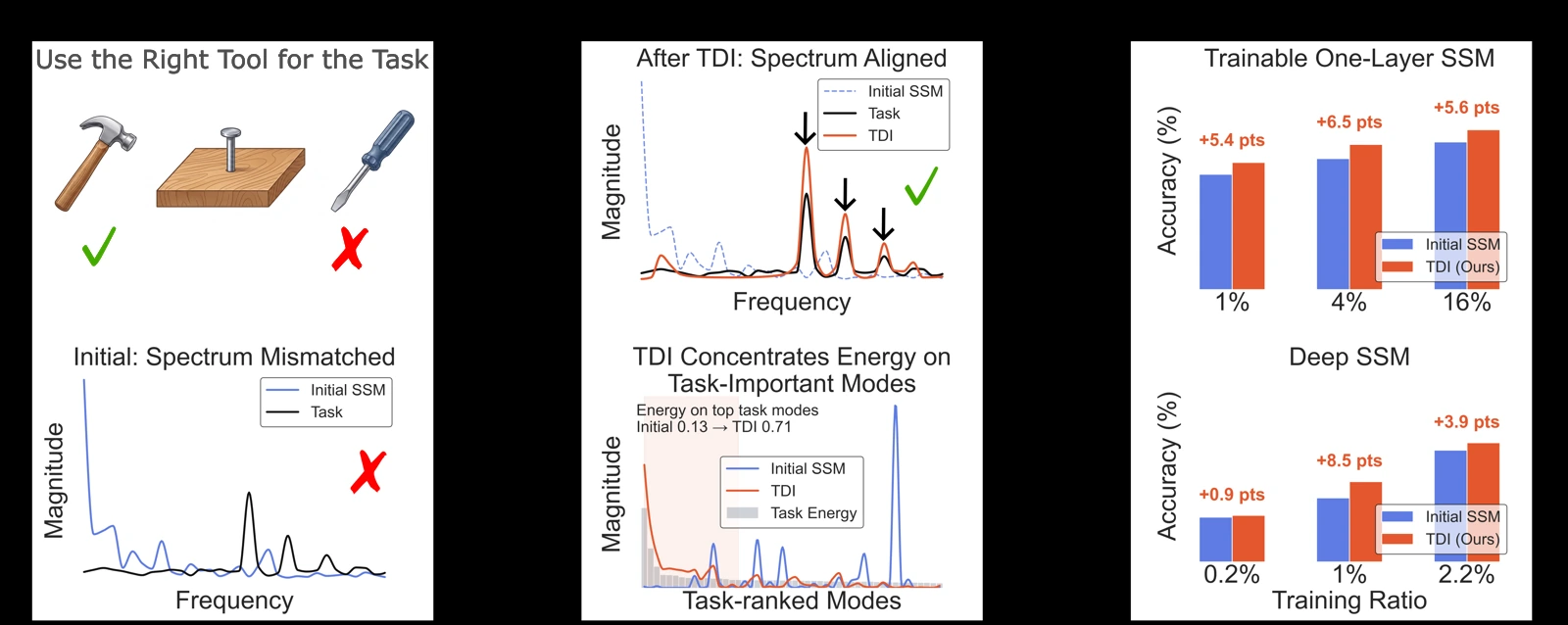
State space models rely on fixed, task-agnostic priors; when this bias mismatches task structure, training consumes extra samples overcoming initialization.
The core idea
Power-Spectrum Matching Initialization
We characterize linear time-invariant state space model bias via the spectrum of its induced kernel and introduce Task-Dependent Initialization (TDI) to match task power spectra.
What we found
Data-Efficient Spectral Generalization
Across synthetic and real-world sequence benchmarks, aligning initial model frequency response with task spectral structure substantially improves sample efficiency when default priors are mismatched.
Continue the question
Related reading
- The Hippocampal Place Field Gradient: A Bio-inspired Framework Building Multiscale Representation for Better Sample EfficiencyICML 2026 · 2026
- Bridging Scales: Spectral Theory Reveals How Local Connectivity Rules Sculpt Global Neural Dynamics in Spatially Extended NetworksNeurIPS 2025 · 2025
Cite this work
Qiyu Chen, Guozhang Chen. Aligning Inductive Bias for Data-Efficient Generalization in State Space Models. NeurIPS 2026.