Communications Biology · 2026 · Journal article
Representation Transfer via Invariant Input-driven Continuous Attractors for Fast Domain Adaptation
Modular recurrent networks form invariant input-driven continuous attractors that enable rapid, few-shot domain adaptation through lightweight readout adapters.
The scientific question
How can neural representations transfer reliably across shifting, noisy real-world domains?
End-to-end deep networks degrade under environmental shifts and require expensive full-model retraining when deployed in noisy, changing conditions.
The core idea
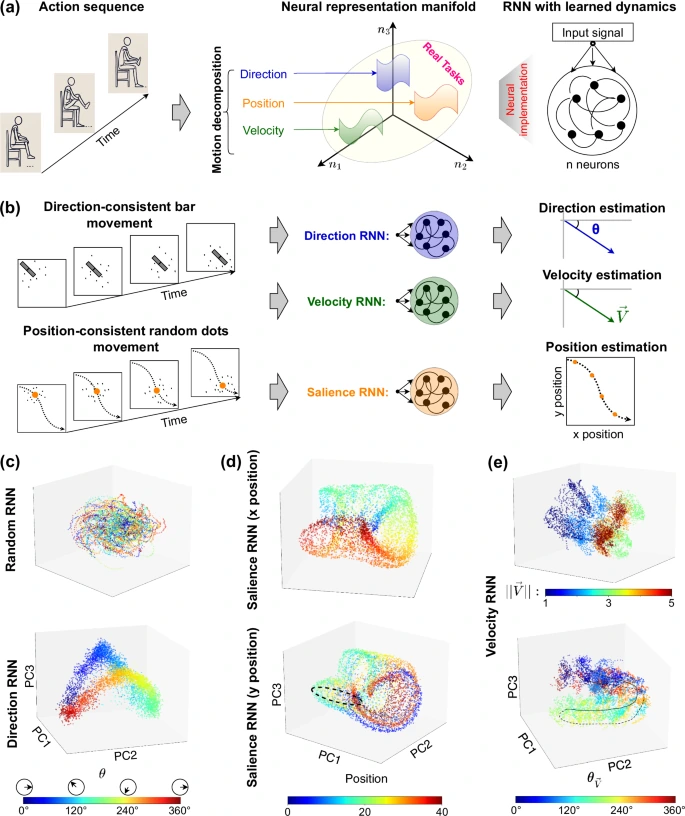
Modular Continuous Attractor Pretraining
Task-agnostic pretraining shapes modular recurrent networks to embed inputs onto low-dimensional, invariant continuous attractor manifolds, requiring only a lightweight adapter for new downstream tasks.
What we found
Parameter-Efficient Few-Shot Adaptation
On gesture and rehabilitation action recognition tasks, the framework achieves accuracy competitive with state-of-the-art methods, especially in few-shot settings, while requiring an order of magnitude fewer parameters and minimal training.
Continue the question
Related reading
- Neural heterogeneity enhances reliable neural information processing: Local sensitivity and globally input-slaved transient dynamicsScience Advances · 2025
- Aligning Inductive Bias for Data-Efficient Generalization in State Space ModelsNeurIPS 2026 · 2026
Cite this work
Tie Xu, Shengdun Wu, Junwen Luo, Yao Yang, Feng Lin, Junjie Jiang, Guozhang Chen, Dongping Yang. Representation Transfer via Invariant Input-driven Continuous Attractors for Fast Domain Adaptation. Communications Biology, 2026. doi:10.1038/s42003-026-09938-8.