bioRxiv · 2026 · Preprint
Sparse cortical dynamics reveal flexible condition-dependent spike-order codes
Combining mouse visual cortex recordings with a data-driven microcircuit model reveals how local connectivity and heterogeneity support flexible spike-order codes.
The scientific question
How do sparse cortical circuits organize spikes into flexible, condition-dependent temporal codes?
Neocortical circuits compute with remarkably few spikes, yet how recurrent wiring avoids rigid temporal pipelines to adapt spike timing remains unclear.
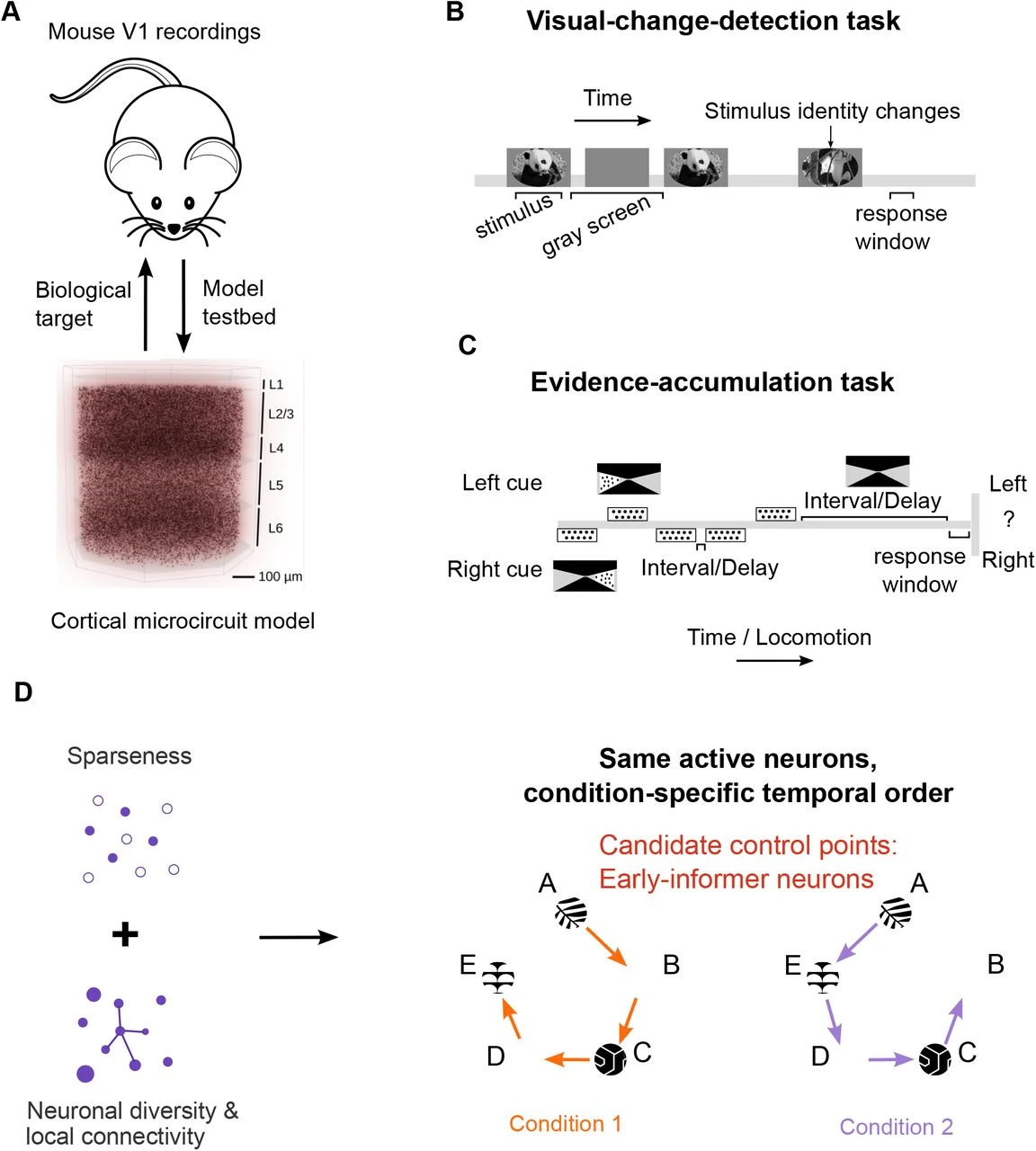
The core idea
Comparing V1 Recordings and Microcircuit Models
We analyze single-trial spike-latency sequences in mouse V1 recordings alongside a task-trained data-driven V1 microcircuit model, performing structural ablations and targeted silencing of high-information early neurons.
What we found
Heterogeneity and Local Wiring Enable Flexibility
Neuronal diversity and distance-dependent local connectivity suppress rigid sequential firing to reproduce condition-dependent spike-order codes, while silencing early informative neurons disrupts low-dimensional task trajectories and decisions.
Continue the question
Related reading
- Data-based large-scale models provide a window into the organization of cortical computationsbioRxiv · 2023
- Neural heterogeneity enhances reliable neural information processing: Local sensitivity and globally input-slaved transient dynamicsScience Advances · 2025
Cite this work
Guozhang Chen, Wolfgang Maass, Franz Scherr. Sparse cortical dynamics reveal flexible condition-dependent spike-order codes. bioRxiv, 2026. doi:10.64898/2026.05.13.724761.